
This ANSWERS page comprises Frequently asked questions and detailed answers.
Click the plus (+) icon to expand the content:
1. Could you share the meaning of "XGM" and "Ten Gates of Mind"?
X represents the number 10 in Roman numerals, corresponding to Thập (Ten) in Sino-Vietnamese. G stands for Gate, and M stands for Mind. When combined, they are Ten (X) Gates of Mind.
Furthermore, in mathematics, X is a variable to be solved—an object of the mind. Thus, X also symbolizes the arising and passing of all phenomena (Dhammas), which are the objects of consciousness.
2. What is the foundation of XGM?
- The content is based on the True Dhamma (Saddhamma) taught by Shakyamuni Buddha during His lifetime. These teachings were recited and compiled into the Pali Nikayas by His 500 noble disciples, all of whom were Arahants. Specifically, this curriculum is inspired by the AN 10.58 Mūlaka Sutta (Rooted in the Blessed One) .
- Additionally, the introduction to the “First Door” incorporates the profound wisdom left to posterity by various saints and realized beings (Sattapurisa).
3. Have you attained enlightenment yourself, or are you still on the path?
I am still a traveler on the path to enlightenment and liberation. My heartfelt aspiration is to spread the Buddha’s path of liberation to all sentient beings. It is my hope that through these shares, many seekers with affinity will find great benefit.
4. How do you know you are practicing in the right direction?
I study and practice according to the Blessed One’s True Dhamma, taking the Discipline as my teacher; thus, I do not lose my way. Furthermore, when discussing or listening to the Dhamma, I always uphold and practice the Four Reliances:
- Rely on the Dhamma, not the person:Do not accept a teaching merely because of the appearance or status of the speaker. One must refer to the original Suttas, self-inquire, and cautiously verify the results through practice.
- Rely on the meaning, not the words:Grasping the core essence of the teaching is more important than clinging to literal words and becoming trapped in concepts.
- Rely on wisdom, not consciousness: One must “know and see” the Dhamma as it truly is, rather than relying on mere intellectual concepts or imaginations.
- Rely on the definitive meaning, not the provisional: Uphold only those teachings that lead directly to enlightenment and liberation, setting aside those that still pertain to the cycle of birth and death (Samsara).
5. If I uphold the "Ten Doors," how long will it take to attain realization, and what level of realization will be achieved?
Question: I understand there are currently two main schools: Theravada (often called “Small Vehicle”) and Mahayana (“Great Vehicle,” including Exoteric and Esoteric traditions). It is said that Mahayana can lead a practitioner to the level of a Bodhisattva in the shortest time, while those following Theravada take a very long time to attain Arahantship. If I uphold the “Ten Doors,” how long will it take to attain realization, and what level of realization will be achieved?
Answer:
- XGM is based on the Nikayascriptural system, leading to awakening, liberation, and the attainment of Arahantship. Whether the time taken is long or short does not depend on the practitioner’s longing, but on their diligent application and persistence. It is like a hen sitting on eight or twelve eggs; if she skillfully and persistently broods them correctly, in due time, the chicks will peck through their shells and emerge on their own, regardless of the hen’s wishes. Conversely, if a hen constantly wishes for chicks but does not brood the eggs skillfully or neglects them, those eggs will never hatch.
- As presented in the core content of XGM, all phenomena ultimately converge in Nirvana. Therefore, whether one receives the “Great Vehicle” or “Small Vehicle” teachings depends on the individual’s faculties (Indriya), karmic affinity, and spiritual vows. It is also essential to remember the characteristics of the Blessed One’s Dhamma: it is apparent here and now, timeless, inviting one to “come and see,”and to be personally realized by the wise. The Dhamma is like a raft or a finger pointing to the moon, meant to keep the practitioner from danger and losing their way. Once you have reached the “other shore”—the shore of enlightenment and liberation—you no longer need to carry the raft and can truly “be a lamp unto yourself.“
One of the pitfalls for some practitioners of certain “Great Vehicle” methods is focusing solely on “insight” or “awareness” while neglecting the purification of Virtue (Sīla), Faith (Saddhā), and Conduct. Consequently, they fail to grow in the Dhamma and may fall into wrong view (Micchā-diṭṭhi), mistaking mere consciousness (Viññāṇa) for true wisdom (Paññā). The prerequisite for entering the first Jhana (meditative absorption) is the removal of the Five Hindrances. Without concentration (Samādhi), wisdom cannot grow; they are like the two wings of a bird—if one is missing, the bird cannot fly. Furthermore, practitioners should note that after receiving a teaching, it is vital to practice with ardor and diligence. Frequently changing one’s practice method is a sign of a doubtful and wavering mind (Vicikicchā). This results in the practitioner struggling without growth, becoming confused, or even regressing from the path.
6. What assurance is there that your shares are in accordance with Buddha’s Teachings and possess real value?
Constant inquiry into the Teachings one hears or sees is essential on the path of study and practice. However, phenomena (Dhammas) must be resolved for the mind to become clear and wise. If one’s understanding is not clear, the practitioner will waver in hesitation and lack ardor. The XGM (Ten Gates of Mind) is distilled from the profound teachings within the Nikāyas, including the following discourses:
1. Long Discourses (Dīgha Nikāya)
- DN 15: Mahānidānasutta — The Great Discourse on Causation
- DN 16: Mahāparinibbānasutta — The Great Discourse on the Buddha’s Extinguishment
2. Middle Discourses (Majjhima Nikāya)
- MN 18: Madhupiṇḍikasutta — The Honeyball
- MN 20: Vitakkasaṇṭhānasutta — The Stabilization of Thoughts
- MN 28: Mahāhatthipadopamasutta — The Longer Simile of the Elephant’s Footprint
- MN 43: Mahāvedallasutta — The Greater Series of Questions and Answers
- MN 44: Cūḷavedallasutta — The Shorter Series of Questions and Answers
- MN 112: Chabbisodhanasutta — The Sixfold Purity
- MN 117: Mahācattārīsakasutta — The Great Forty
- MN 118: Ānāpānassatisutta — Mindfulness of Breathing
- MN 119: Kāyagatāsatisutta — Mindfulness of the Body
- MN 140: Dhātuvibhaṅgasutta — The Exposition of the Elements
3. Linked Discourses (Saṃyutta Nikāya)
- SN 12.10: Gotamasutta — Gotama
- SN 12.63: Puttemaṃsasutta — A Child’s Flesh
- SN 22.54: Bījasutta — The Seed
- SN 22.79: Khajjanīyasutta — Being Devoured
- SN 22.81: Pālileyyasutta — At Pārileyyaka
- SN 22.87: Vakkalisutta — Vakkali
- SN 48.10: Dutiyavibhaṅgasutta — Analysis (2nd)
- SN 56.11: Dhammacakkappavattanasutta — Rolling Forth the Wheel of Dhamma
4. Numbered Discourses (Aṅguttara Nikāya)
The contents of these Suttas are readily available on www.suttacentral.net in the original Pali, as well as English, Vietnamese, and many other languages. The English versions are the esteemed translations by the Ven. Bhikkhu Sujato and Ven. Bhikkhu Bodhi. When the conditions are right, XGM will upload summaries of these Suttas to the website and various social platforms for seekers with affinity to reference.
7. Is there a contradiction between relying on the Dhamma and the goal of achieving liberation and freedom?
- Before reaching enlightenment—while we are still “bound“—we must rely on the right view of the Buddha, the Arahants, and the Perfectly Enlightened Ones to know which path to tread and which way to go. The Discipline (Vinaya) acts as a shield, protecting us from the forces of Mara. It is like a carpenter using a small wooden wedge to drive out another wedge. For further study. The practitioners can refer to the discourse MN 20 Vitakkasaṇṭhāna Sutta (The Removal of Distracting Thoughts).
8. What guarantees do you offer for the content shared by XGM (Ten Gates of Mind)?
I can confidently offer the following assurances:
- The motivation for sharing stems from wholesome faith (Saddha)for the happiness of all sentient beings.
- The content is based on the True Dhamma that I have personally read, understood, and upheld.
My mind is entirely detached, seeking no personal gain or specific outcome from this sharing.
9. How are your activities and organization operated and maintained?
My deepest aspiration is to serve as a vessel and a megaphone to spread the teachings of Shakyamuni Buddha. Out of compassion for the happiness of all beings, He discovered, taught, and left behind a path for us to follow and escape suffering. This is the sole reason I built and developed the XGM website.
Alongside the articles on this site, I will create presentations and videos focused on guiding practitioners. I also use this platform to receive feedback from fellow practitioners and enlightened seekers.
10. Do you accept support from sponsors or donors?
All shared content is provided entirely free of charge. Our materials do not feature advertisements or affiliate links for commission, as this would violate the principle of Right Livelihood by “trading the Buddha’s Dhamma.” However, financial support from great donors (Dāyaka) for the construction and maintenance of this website is necessary and highly praised. Such contributions help spread the Blessed One’s True Dhamma, which He realized and taught out of great compassion for the welfare of all living beings.
11. Why do so many people practice the Buddha's Dhamma, yet we see so few who have attained Enlightenment?
- This is a question every practitioner should ask themselves: “Why have I practiced for so long, yet I still suffer and find no progress?”
- Is it because our practice is insufficient, or perhaps too extreme?
12. What is your own method of study and practice?
I still follow the traditional, manual way: reading the original Suttas, transcribing them, contemplating deeply, engaging in self-reflection (Hồi quan tự kỷ), and practicing strictly according to the Blessed One’s instructions.
13. Why is the Dhamma readily available and studied by many, yet so few realize the Fruits of the path?
Because Knowing, understanding, seeing, and realizing are entirely different stages:
- One who knows the Path:One who has heard the Teachings and studied them.
- One who understands the Path:After knowing, they discuss and contemplate the Dhamma to gain clarity.
- One who sees the Path:After hearing and discussing, they practice and personally “see” what was described in the scriptures.
- One who attains the Path:They hear, discuss, practice, and bring the practice to perfection.
It is possible that many have attained the Path, but we may not yet have the karmic affinity to meet them.
14. How can we know if someone has attained Enlightenment?
The Buddha taught several criteria, summarized as follows:
- Through living together, one comes to know a person’s Virtue (Sīla).
- Through communication (working together), one comes to know their Purity.
- Through adversity (hardship), one comes to know their Fortitude.
- Through discussion, one comes to know their Wisdom.
The Buddha emphasized that this observation must occur over a long period, with careful attention, and by a person who is wise.
15. Why is Mindfulness of Breathing presented so clearly and simply, yet people still practice many other different methods?
It is only through deep karmic affinity and accumulated merit that one can truly know and practice this path. Before one can effectively practice Mindfulness of Breathing, the practitioner’s foundation must reach nine specific stages as described below:
- 1.Faith (Saddhā-indriya): Establishing a firm root of faith in the Dhamma.
- 2.Turning the Mind: A complete redirection of one’s mental focus toward liberation.
- 3.Strong Resolve: Making a courageous and powerful vow to practice.
- 4.Strict Observance of Precepts: Diligently upholding the moral precepts and practicing to achieve Purity of Virtue (Sīla-visuddhi).
- 5.Guarding the Sense Faculties: Restraining the senses to prevent the arising of unwholesome states.
- 6.Moderation in Eating: Being mindful and disciplined in the consumption of food.
- 7.Inward Vigilance: Constantly monitoring and examining one’s internal mental states.
- 8.Mindfulness and Clear Comprehension (Sati-sampajañña): Maintaining presence of mind in all postures and activities.
- 9.Inward Contemplation to Transcend the Five Hindrances: Using internal observation to overcome desire, ill will, sloth, restlessness, and doubt.
- Only when these nine stages are accomplished can one enter Concentration (Jhana) and give rise to Wisdom (Paññā) through the practice of Mindfulness of Breathing.
16. Why does XGM focus on the theme of death? Doesn't it seem negative and pessimistic?
The core focus of XGM is the total eradication of the root of suffering—the resolution of the Mass of Suffering (Birth, Aging, Sickness, and Death). This is the essence of the Four Noble Truths set in motion in the first discourse: the Dhammacakkappavattana Sutta (SN 56.11). The Blessed One consistently reaffirmed this in the Alagaddūpama Sutta (MN 22): “Bhikkhus, formerly as now, I teach only suffering and the cessation of suffering.”
Recognizing suffering is not pessimism but objective reality. Since “Peace is the inherent nature, while suffering is conditioned,” once the conditions for suffering are removed, peace naturally reveals itself. Furthermore, the Buddha taught practical ways for lay followers to live according to their circumstances:
- Mahānāma Sutta (AN 11.11) : Abiding in the 5 Faculties and practicing the 6 Recollections to remain calm amidst worldly life.
- Dīghajāṇu Sutta (AN 8.54): Guidelines for 4 qualities leading to present happiness (Diligence, Protection, Good friendship, Balanced living) and 4 for future happiness (Faith, Virtue, Generosity, Wisdom).
Life and death are the critical bottleneck,
Resolve this well, all the rest are met
Not prepared ahead, and the test is near
For sudden storms flashing from the sky
Man’s good or bad lucks suddentlly arrives
Who knows if tomorrow or the next life
which of them will come to us first?
17. Why did Anāthapiṇḍika, Visākhā and Ven. Ānanda remain at the stage of Stream-entry for so long?
- Anāthapiṇḍika and Visākhā: They were noble disciples (sekha) living as householders. With unshakable faith, they chose to remain in lay life to provide a steadfast financial pillar, offering great monasteries (Jetavana and the Eastern Monastery) to create optimal conditions for the Sangha.
- Venerable Ānanda: He attained Stream-entry early but remained a sekha for 25 years while serving as the Buddha’s attendant. This was the embodiment of devotion: he sacrificed his private meditation time to care for the Blessed One and memorize all His teachings. It is thanks to his dedication that we have the Nikaya Suttas today. He only attained Arahantship just before the First Buddhist Council, after fulfilling his mission as the personal attendant.
18. How do you feel about the possibility that your shares may meet with disagreement or criticism?
I share these personal insights from my journey of studying and practicing the Buddha’s teachings with the sole aspiration of bringing benefits to readers with whom I share a Dhamma connection. I hold nothing back for myself, nor do I wish to bind anyone to me. I believe that with a heart of goodwill and detachment, all phenomena (dhammas) come and go without hindrance—much like moonlight passing through a window, leaving no trace behind.
In this regard, I always uphold the Blessed One’s teachings from two core discourses:
- The Mahāparinibbāna Sutta (DN 16):When Venerable Ānanda was filled with fear at the thought of the Blessed One’s passing into Nirvāna, the Blessed One taught: ‘Ānanda, I have taught the Dhamma without making any distinction between inner and outer (between secret teachings for disciples or public ones for the masses). For in regard to the Dhamma, the Tathāgata is never a teacher with a “closed fist” (holding back no secrets to bind his disciples).’ I also vow to share wholeheartedly everything I understand, without any intention of hoarding knowledge or creating attachments.”.
The Alagaddūpama Sutta (The Simile of the Snake, MN 22): The Buddha taught that if others revile or slander you, you should not give way to anger or resentment; conversely, if others honor and revere you, you should not feel elated or delighted. When facing either extreme, one should reflect: “These are merely actions directed toward the Five Aggregates (suffering) which I have already fully understood.” Understanding this, I accept all feedback with selflessness, knowing it is simply the natural operation of phenomena.
THE LIFE OF THE BUDDHA
“The Buddha” is the title of veneration given to Prince Siddhattha Gotama after his Full Awakening, literally meaning “The Awakened One” or “The Enlightened One.”
- Prince Siddhattha Gotama was a real historical figure, born in the Lumbini grove and raised in the royal palace of Kapilavatthu—two historical sites located in modern-day Nepal. His mother was Queen Māyā, and his father was King Suddhodana, the leader of the Sakyan clan.
- Before his Awakening, he lived a worldly life like anyone else. However, upon realizing the suffering of birth, aging, illness, and death that binds humanity, he resolutely went forth from the home life into homelessness at the age of 19, seeking the unexcelled sanctuary from bondage. After five years of studying under various teachers and six years of practicing extreme asceticism—which failed to bring liberation—he sat in deep meditation for 49 days and nights. Ultimately, he realized the Threefold Knowledge and attained Supreme Full Awakening under the Bodhi tree in Uruvelā, now known as Bodh Gaya, Bihar State, India.
Below is the detailed content divided into 4 major themes regarding his life: Buddha – Dhamma – Saṅgha – Vinaya.
According to the tradition and extant texts of the Mahāyāna school, the information regarding the life of the Buddha is summarized as follows (see the explanatory notes in section 4 below):
1. Birth – Marriage – Going Forth
The Birth
- On the 8th day of the 4th lunar month in the year 624 BCE, Queen Māyā gave birth to Prince Siddhattha in the Lumbini grove, while traveling from the city of Kapilavatthu back to her maternal homeland of Koliya to give birth according to the customs of that era. According to traditional legends, immediately upon his birth, the Prince took seven steps, and each footstep was supported by a lotus flower. After surveying the four directions, he faced North, pointed one hand toward the heavens and the other toward the earth, and solemnly declared: “Above the heavens and below the earth, I (the knowing) is the foremost.”
- On the festival celebrating the Prince’s birth, his royal father Suddhodana invited the mountain hermit, the ascetic Asita, into the palace to examine the Prince’s physical characteristics. Upon beholding the “32 Marks of a Great Man,” the ascetic prophesied that if this child remained in the household life, he would become a Wheel-turning Monarch (Cakkavatti) ruling over the world; but if he went forth from the home life, he would become a supreme religious leader, a Fully Awakened One (Sammā-sambuddha).
- Seven days after giving birth to the Prince, Queen Māyā passed away. The Prince was then loved, cared for, and nurtured by his maternal aunt, Mahāpajāpatī Gotamī—the younger sister of Queen Māyā.
The Marriage
- His royal father and the royal family always desired that he inherit the throne in the future rather than becoming a religious leader. Consequently, the court constantly arranged for him to live in utmost luxury, insulated from social realities and restricted from contact with ascetics.
- When he turned 16 years of age, an arrangement was made for him to marry Princess Yasodharā—the daughter of King Suppabuddha and Queen Pamitā of the Koliya kingdom—with the deliberate purpose of binding him to the worldly lifestyle.
The Going Forth
- At the age of 19, on the night of the 8th day of the 2nd lunar month in the year 605 BCE, upon hearing the newborn cry of his son, Rāhula, he was immediately reminded of the images of the old man, the sick man, the dead man, and the ascetic whom he had previously encountered during his excursions through the four gates of Kapilavatthu. Those visions once again stirred his heart deeply. He reflected to himself: “Human beings are born into this world only to grow old, fall sick, and die; no one can bear this suffering on our behalf. Therefore, I must make my own effort to find the path of liberation from this mass of suffering for myself and for all living beings.” Inspired by the ascetic who lived freely and unhindered like space, he realized that the household life is full of fetters, a path of dust, where it is difficult to practice the holy life. He resolved: “Let me shave off my hair and beard, put on the yellow robes, and go forth from the home life into homelessness.”
- That very night, he commanded his charioteer Channa to prepare his horse Kanthaka, and together they quietly departed from the city of Kapilavatthu to seek spiritual training. Having traveled far from the capital and reached the banks of the River Anomā, he shaved off his hair and beard with his own hands. He then handed over his royal garments and jewelry, instructing Channa to take the horse Kanthaka back to the capital to inform his royal father and the royal family that he had resolutely gone forth, seeking the path of liberation from the suffering of birth, aging, sickness, and death. Proceeding alone on foot into the deep forest, he met a hunter along the way and proposed exchanging his precious royal attire for the hunter’s coarse, rag-robe. (Back to Content Table)
2. The Quest for the Way – The Practice of Asceticism
The Search for Teachers (605–600 BCE)
- Having gone forth in this manner, with the desire (chanda) to seek what is wholesome, the unexcelled supreme path to peace, he approached his first teacher, Āḷāra Kālāma, expressing his wish to practice within this Dhamma and Vinaya. Before long, he realized the teacher’s highest meditative attainment, the Dimension of Nothingness. However, he realized that this state of concentration did not lead to disillusionment, dispassion, cessation, peace, direct knowledge, awakening, and Nibbāna; therefore, he took his leave. Next, he approached Udaka Rāmaputta to study under him and quickly attained the highest meditative state that his teacher had realized, the Dimension of Neither-Perception-Nor-Non-Perception. Recognizing once more that this method still did not lead to the supreme wisdom and Nibbāna, he decided to abandon it and continued his journey in search of the unexcelled sanctuary, Nibbāna.
Ascetic Practices (600–594 BCE)
- In due course, he wandered through the kingdom of Magadha and stopped at a serene forest by the Nerañjarā River, near the town of Senānigama in the district of Uruvelā. There, he met the five companions led by Kondañña and together they practiced extreme forms of asceticism, including breath-retention and severe fasting. Consuming only a single sesame seed each day, his body became extremely emaciated, his bones showed clearly through his skin, and his physical vitality gradually withered away. At that critical moment, a young village woman named Sujātā passed by. Seeing him on the verge of physical collapse, she reverently offered him a bowl of milk-rice (kheer). After consuming the meal, his strength was restored. He realized that the practice of extreme self-mortification over the years had not helped him achieve the goal of Nibbāna, but had only depleted his physical energy. Consequently, he decided to abandon this path of self-torment. This shift in practice caused Kondañña and his four companions to leave him in disappointment, as they believed he had fallen away from his striving and returned to a life of material abundance. (Back to Contents Table)
3. The Awakening – Sharing the Dhamma – Parinibbāna
The Awakening
- Following his decision to abandon the practice of extreme self-mortification, he sat beneath the Bodhi tree to practice meditation (jhāna), with the firm resolution not to rise until he had attained Nibbāna. Sitting cross-legged with his back straight, ardent, clearly comprehending, and mindful, he turned his awareness inward, exploring the deep recesses of his mind. He recalled his past lives when he was still a Bodhisatta, remembering how he used to reflect: “Truly, this world has fallen into trouble: it is born, it ages, it dies, it passes away, and it is reborn; yet from this suffering, no escape is known from aging and death. When will an escape be known from this suffering, from aging and death?” At that moment, he attended wisely to dependent origination: “When what exists does aging and death come to be? With the cessation of what does aging and death cease?” He clearly saw: “This is suffering, this is the origin of suffering, this is the cessation of suffering.” Regarding things unheard of before, vision arose, knowledge arose, wisdom arose, true knowledge arose, light arose. Then, at that moment, he saw an ancient path, an ancient track traveled by the Fully Awakened Ones of old, which is the Noble Eightfold Path. At that time, he followed that path and directly knew:
Aging and death, the origin of aging and death, the cessation of aging and death, and the way leading to the cessation of aging and death (The Four Noble Truths).
Birth, existence, grasping, craving, feeling, contact, the six sense bases, name-and-form, and then consciousness. This consciousness turns back, it goes no further than name-and-form (The Principle of Dependent Origination).
Choices, the origin of choices, the cessation of choices, and the way leading to the cessation of choices (The Process of the Five Aggregates).
— (SN 12.65 Nagara Sutta – The City)
- After 49 days and nights of continuous meditative contemplation, the Blessed One realized the Threefold Knowledge and attained the unexcelled sanctuary from bondage, Nibbāna. And knowledge and vision arose in him: “My liberation is unshakable; this is my last birth; now there is no more rebirth.” In this manner, he accomplished supreme Buddhahood beneath the Bodhi tree by the Nerañjarā River in Uruvelā on the 8th day of the 12th lunar month in the year 594 BCE, at the age of 30.
Dhamma Discourses
- Immediately after his Awakening, the Blessed One reflected: “This Dhamma that I have realized is deep, hard to see, hard to understand, peaceful, sublime, beyond the sphere of reasoning, subtle, to be experienced by the wise. But this generation delights in attachment, takes pleasure in attachment, rejoices in attachment. It is hard for such a generation to see this truth, namely, specific conditionality, dependent origination. And it is hard to see this truth, namely, the stilling of all formations, the relinquishing of all attachments, the destruction of craving, dispassion, cessation, Nibbāna. If I were to teach the Dhamma and others did not understand me, that would be wearying and troublesome for me.”
However, Brahma Sahampati, knowing the Blessed One’s thoughts, came to persuade him, saying that there are beings “with little dust in their eyes” who would understand the Dhamma. Out of compassion, the Blessed One surveyed the world with the eye of a Buddha and saw the diversity in the faculties of beings. For those with sharp faculties, with little dust in their eyes, with good dispositions, who are easy to teach and who clearly see the danger in unwholesome kamma that leads to rebirth in various realms, he agreed to teach the Dhamma for the benefit of the world.
He asked himself: “To whom should I teach the Dhamma first? Who will understand this Dhamma quickly?” Initially, he thought of his two former teachers, Āḷāra Kālāma and Udaka Rāmaputta, as they could grasp it very rapidly. But with his purified divine ear, surpassing that of humans, he heard the deities inform him that they had passed away seven days and one day ago, respectively. Next, he thought of the group of five companions led by Kondañña. With his purified divine eye, surpassing that of humans, he saw the group of five currently residing in the Deer Park (Migadāya) at Isipatana, near Bārāṇasī. After staying in Uruvelā for as long as he wished, he set out for Bārāṇasī.
On the road to the Deer Park, he met an Ajivika ascetic named Upaka. Struck by the Blessed One’s majestic appearance, Upaka asked who his teacher was. Upon hearing the Buddha declare himself to be the Supreme One, the Fully Awakened One, Upaka shook his head and took a different path.
- (Note: It is a great misfortune for someone to be born in the same era and meet the Buddha but lack the spiritual supportive conditions to receive the Dhamma. Although we were not born in the same era and cannot meet the Buddha directly, our ability to access his true Dhamma today is due to our profound store of past wholesome merits.). (XGM)
- The Venerable Kondañña was the first disciple to attain attain the Dhamma-eye hearing the Dhamma; the other four companions likewise attained the same a few days later. After hearing the subsequent Discourse on the Characteristic of Non-Self (SN 22.59 Anattalakkhaṇa Sutta), all five (Koṇḍañña, Vappa, Bhaddiya, Mahānāma, Assaji) completely destroyed the taints (āsava) and realized the fruit of Arahantship. Among them, the Venerable Assaji was the one who later planted the seeds of the Dhamma to convert the Venerable Sāriputta during an alms round.
- Throughout 49 years (593–544 BCE) of teaching living beings and accepting disciples, the Buddha built and developed a strong monastic community (Saṅgha). He guided a community of over 1,250 Arahants and countless people to realize the fruits of Stream-entry, Once-returning, Non-returning, or rebirth in heavenly realms.
Entering Parinibbāna
- In the Sāla grove of the Mallans near the city of Kusinārā, on the 15th day of the February lunar month in the year 544 BCE, the Blessed One attained final extinguishment (Parinibbāna), having lived a life of 80 years. (Back to Content Table)
4. Analytical Chart and Commentary
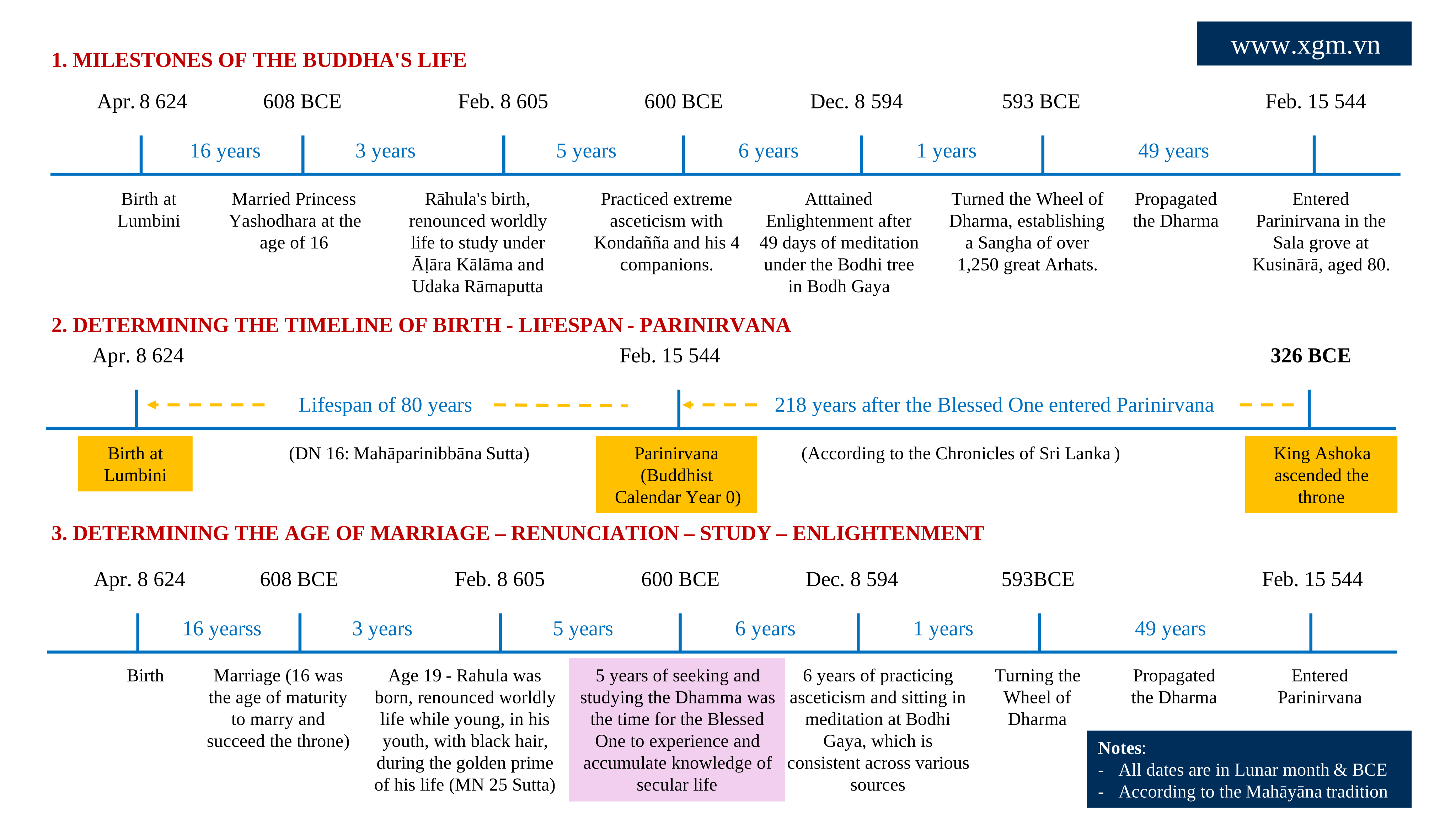
4.1 Commentary
- During the Buddha’s time, the people of Jambudīpa (the Indian subcontinent), across the sixteen great nations, seemed unconcerned with chronological systems, focusing instead on philosophy. The discourses compiled in later times clearly reflect this tendency. For instance, the Dhamma of the Blessed One is praised as “well-expounded, timeless, inviting one to come and see…” and the discourses typically begin with the phrase, “Thus have I heard. On one occasion the Blessed One was living at Sāvatthī…” without mentioning any specific calendar date. For this reason, determining the chronological milestones related to the life of the Blessed One must rely on textual evidence and arguments. Although there is very little information considered historically certain, we can be reasonably confident that Prince Siddhattha Gotama was an actual historical figure. At the same time, the content of his teachings was recorded by his great disciples, preserved and propagated by generation after generation of the Saṅgha up to the present day. This doctrinal system is rigorous, consistent, and profoundly practical, transcending the prejudice that these are merely products composed by later generations.
- The content presented in the section “The Life of the Buddha” aims to provide readers with a persuasive argument rather than an absolute assertion, helping you to achieve a comprehensive, overarching, and consistent view. Today, there is a harmonious convergence of thought among various Buddhist schools, and this is completely in accord with the teaching of the Blessed One: “My Dhamma has only one taste, the taste of liberation.”
- However, there currently exist discrepancies regarding the timeline of two major events: the time of his renunciation, and the duration of his spiritual quest from the time of renunciation until his enlightenment. Other chronological milestones will shift depending on when these two events took place. In this document, these two milestones are presented according to the Mahāyāna tradition. Accordingly, the Prince went forth into homelessness at the age of 19 and attained awakening after 11 years of seeking the truth, studying, practicing austerities, and spending 49 days in meditation.(Back to Content Table).
Click on the plus sign (+) to view the details of this argument.
In this section, we will analyze and evaluate the grounds supporting two chronological milestones: Prince Siddhattha Gotama went forth at the age of 19 and attained awakening at the age of 30. This content primarily concerns historical knowledge and is not directly related to the wisdom of liberation; therefore, readers may skim through it if they wish. However, if you are interested in exploring it, this knowledge will become an object of the mind (a dhamma) that needs to be clearly recognized. Thoroughly understanding it helps the mind cease to give rise to perplexity or hesitation when mentioning this topic in the future. When doubt ceases and the current of thought does not arise, the mind will come to rest. Furthermore, the dialectical method employed here is to use one phenomenon (dhamma as intellectual information) to transform or clarify another phenomenon, similar to how the Blessed One instructed in the Discourse on the Stilling of Thoughts (MN 20: Vitakkasaṇṭhāna Sutta)—using one wholesome state to dispel another, just as a skilled carpenter knocks out a coarse peg with a finer one.
1. Grounds for the Milestone of Going Forth at Age 19
- The Discourse on the Noble Quest (MN 26: Pāsarāsi Sutta): The Blessed One described his state when he went forth as being very young, full of youthful vitality: “Later, while still young, a black-haired young man endowed with the blessing of youth, in the prime of life, though my mother and father wished otherwise and wept with tearful faces, I shaved off my hair and beard, put on the yellow robes, and went forth from the home life into homelessness.” This detail aligns with the Mahāyāna tradition’s view of a Prince who went forth in his youth (at age 19), rather than at the mature age of later adulthood (at age 29).
- The Discourse on the Advice to Rāhula at Ambalaṭṭhika (MN 61: Ambalaṭṭhika-rāhulovāda Sutta): About a year after his awakening, the Blessed One returned to the capital of Kapilavatthu. There, the Venerable Rāhula met his father for the first time and was permitted to go forth as a novice (sāmaṇera) at around twelve years of age. Upon entering the Saṅgha, the Venerable Rāhula was placed under the guidance of the Venerable Sāriputta. Still accustomed to the disposition of a royal prince, being pampered, and aware of his father’s status within the Saṅgha, the Venerable Rāhula would sometimes mischievously tell lies to tease others. The matter was reported to the Buddha, who admonished him strictly yet compassionately through this discourse. A novice possessing such an active, playful psychology, and the profound depth of this discourse, fits the psychology of a twelve-year-old child much better than that of a seven-year-old. This further strengthens the timeline of the 19-year-old renunciation theory, at which point the Venerable Rāhula had just been born.
2. Grounds for the Milestone of 11 Years of Seeking the Truth and Practicing Austerities
- In ancient India, journeying on foot through deep forests and rugged mountains to seek out spiritual masters and study doctrines could not happen quickly or easily. Although the Nikayas record that the Buddha experienced no difficulty in attaining the highest meditative absorptions (the base of nothingness and the base of neither-perception-nor-non-perception) from his first two teachers, this does not mean that the entire process of seeking the truth occurred within a few short months.
- Therefore, the initial period of five years seeking the truth under the two teachers Āḷāra Kālāma and Udaka Rāmaputta was a necessary sequence of days for him to experience, contemplate, and fully accumulate the life of an ascetic mendicant. Only after this stage did he move to the Nerañjarā River in the region of Uruvelā to join the five bhikkhus led by Koṇḍañña, dedicating himself to the path of extreme austerities for the following six years. In total, this 11-year journey of seeking the truth and practicing austerities is a logical progression, perfectly fitting to lead a Prince who went forth at the age of 19 to reach the pinnacle of realization at the age of 30. (Back to Content Table)
1. Turning the Wheel of Dhamma
After attaining awakening and having stayed at Uruvelā as long as he liked, the Blessed One wandered by stages to Bārāṇasī, to Isipatana, the Deer Park, where the group of five bhikkhus led by Koṇḍañña were staying.
When the group of five bhikkhus saw the Blessed One coming from afar, they colluded and agreed among themselves: “Friends, here comes the ascetic Gotama; he lives in luxury, he has abandoned striving, and has reverted to a life of abundance. When he arrives, we should not pay homage to him, nor rise up for him, nor take his robe and bowl. We will simply set out a seat for him; if he wishes, he may sit down.”
Despite their agreement, as the Blessed One drew closer, his sublime appearance was such that the group of five bhikkhus could not keep their pact and automatically rose from their seats. One came forward to receive and take his robe and bowl, another prepared a seat, and another brought water for the Blessed One to wash his feet.
Then the Blessed One said to the group of five bhikkhus: “Bhikkhus, the Tathāgata does not live in luxury, nor has he abandoned striving, nor reverted to a life of abundance. The Tathāgata is an Arahant, a Perfectly Enlightened One. Lend your ears, the Deathless has been attained! I instruct you, I teach the Dhamma. If you practice according to my instructions, it will not be long before you realize for yourselves, through direct knowledge, here and now enter and remain in that supreme goal of the holy life for the sake of which clansmen rightly go forth from the home life into homelessness.”
After the Blessed One convinced the group of five bhikkhus, he began to teach them. At that time, he arranged for the bhikkhus to take turns listening to the Dhamma and going for alms. While the Blessed One instructed two bhikkhus, the other three went for alms to bring food back for all six. The next day, the three bhikkhus stayed at the dwelling to listen to the Dhamma, while the other two went for alms to bring food back for all six.
There, the Blessed One addressed the group of five bhikkhus: “Bhikkhus, these two extremes should not be practiced by one who has gone forth:
- The pursuit of sensual happiness in sensual pleasures (kāmesu), which is low, vulgar, the way of worldlings, ignoble, and unbeneficial.
- The pursuit of self-mortification, which is painful, ignoble, and unbeneficial.
Without veering towards either of these extremes, the Tathāgata has awakened to the Middle Way, which gives rise to vision, gives rise to knowledge, and leads to peace, to direct knowledge, to enlightenment, to Nibbāna.”
The Blessed One then taught the Four Noble Truths, which are the four realities: what suffering is (The Noble Truth of Suffering), the cause that accumulates that suffering (The Noble Truth of the Origin of Suffering), the complete cessation of the cause that generates suffering (The Noble Truth of the Cessation of Suffering), and the path of practice leading to the cessation of suffering (The Noble Truth of the Way Leading to the Cessation of Suffering, which is the Noble Eightfold Path). The Blessed One pointed out that each “Truth” involves three phases of understanding, known as the Three Turnings (the turning of vision, the turning of duty, and the turning of realization), specifically:
- The Noble Truth of Suffering: This is suffering; This suffering should be fully understood; This suffering has been fully understood.
- The Noble Truth of the Origin of Suffering: This is the origin of suffering; This origin of suffering should be abandoned; This origin of suffering has been abandoned.
- The Noble Truth of the Cessation of Suffering: This is the cessation of suffering; This cessation of suffering should be realized; This cessation of suffering has been realized.
- The Noble Truth of the Way Leading to the Cessation of Suffering: This is the way leading to the cessation of suffering; This way leading to the cessation of suffering should be developed; This way leading to the cessation of suffering has been developed.
As long as the Tathāgata’s knowledge and vision of reality regarding these Four Noble Truths with their three turnings and twelve aspects was not thoroughly purified, then the knowledge and vision arose in me: “Unshakeable is my liberation of mind. This is my last birth. Now there is no more rebirth.”
This is what the Blessed One said. The group of five bhikkhus were glad and rejoiced in the Blessed One’s words. While this discourse was being spoken, there arose in the Venerable Koṇḍañña the dustless, stainless Dhamma-eye: “Whatever is subject to origination is all subject to cessation.”
And when this Wheel of Dhamma was thus turned by the Blessed One, successively from the lower to the higher realms, the devas of the three realms raised a cry: “At Bārāṇasī, in Isipatana, the Deer Park, this supreme Wheel of Dhamma has been set in motion by the Blessed One, a wheel that cannot be stopped by any ascetic or brahmin or deva or Māra or Brahmā or by anyone at all in the world.”
Thus in that instant, in that second, in that moment, the cry reached as far as the Brahmā realm. And this ten-thousandfold world system shook, quaked, and trembled. And an immeasurable, magnificent radiance appeared in the world, surpassing the divine majesty of the devas. [Setting in Motion the Wheel of the Dhamma (SN 56.11 Dhamma- cakkappavattana-Sutta)]
2. Core Teachings
- Consisting of 58 worldly phenomena (dhamma) that need to be fully understood and developed, which are presented in detail on the page “Analysis” – Section 7.”
Throughout the forty-nine years of turning the Wheel of Dhamma (from 593 to 544 BCE), the Blessed One established a pure community of disciples (the Saṅgha). He guided a congregation consisting of more than 1,250 great Arahants, alongside countless devas and lay disciples who attained stages of awakening. The chronological order in which the core great disciples took refuge and the key lay supporters offered their patronage proceeded as follows:
1. The Process of Formation and Development of the Saṅgha
1. The Origin at the Deer Park (Migadāya)
After attaining awakening, the Blessed One traveled on foot to the Deer Park (near the city of Bārāṇasī). Here, he set the Wheel of Dhamma in motion for the first time, proclaiming the Four Noble Truths.
- Aññā Koṇḍañña: attained the Dhamma-eye during the very first discourse, becoming the first disciple to realize the truth, while the other four attained the Dhamma-eye a few days later.
- The Group of Five Bhikkhus: After hearing the subsequent Discourse on the Characteristic of Non-Self (SN 22.59 Anattalakkhaṇa Sutta), all five (Koṇḍañña, Vappa, Bhaddiya, Mahānāma, Assaji) completely destroyed the taints (āsava) and realized the fruit of Arahantship. The primitive community officially consisted of five noble monastics.
2. Accepting the Clan Son Yasa and 54 Gentlemen
- “In Bārāṇasī, there was a young clan-son (Yasa) who enjoyed all five strands of sensual pleasure. One night, upon waking up and seeing his attendants and concubines sleeping in a disheveled manner, Yasa experienced a sense of spiritual urgency and disillusionment. Consequently, he left his home to wander toward Isipatana, the Deer Park (Migadāya).
- At that time, the Blessed One was walking up and down in the open air during the early morning. Hearing Yasa exclaim, ‘It is distressing! It is oppressive!’, the Blessed One called out to him, stating that here it was not oppressive and not distressing. Hearing this, Yasa was delighted, approached the Blessed One, paid homage to Him, and sat down to one side.
- The Blessed One then taught Yasa the progressive discourse (Anupubbīkathā) and the Four Noble Truths:
- The Progressive Discourse (Anupubbīkathā): Practicing generosity with an open mind and maintaining moral virtue without violating the precepts so as not to harm oneself or others, thereby receiving the karmic reward of being reborn in heavenly realms to enjoy celestial bliss. However, infatuation with worldly sensual pleasures can lead to downfall when life ends. Therefore, it is necessary to arouse the mind to seek the world-transcending Dhamma to escape the cycle of birth and death (samsara).
- The Four Noble Truths: After observing that the listener’s mind was ready, malleable, joyful, and clear of hindrances, and that pure confidence had arisen, the Blessed One then expounded the Four Noble Truths.
- Right at that moment, Yasa gave rise to the pure Eye of Dhamma, realizing the nature of arising and ceasing of all phenomena, and attained the fruit of stream-entry (Sotāpatti).
- When the father followed his son’s footprints, they led him to the Blessed One’s presence, but he could not see Yasa (as eyes was blinded by the Blessed One’s psychic power). After paying homage and sitting down to one side, he was taught the progressive discourse (Anupubbīkathā) and the Four Noble Truths (as mentioned above) by the Blessed One. He then also attained the pure Eye of Dhamma and requested to take refuge in the Triple Gem, becoming a lay disciple (Upāsaka).
- While sitting and listening to the Blessed One teaching the Dhamma to his father, Yasa contemplated deeply according to the teaching; his mind was completely freed from clinging, liberated from all defilements (asavas), and he realized the fruit of Arahantship (Arahant). Upon hearing the news that the clan-son Yasa had gone forth, his four close friends and fifty other young clan-sons came to find him and were sequentially led by Yasa to listen to the Blessed One’s Dhamma. After listening to the progressive discourse (Anupubbīkathā) and the Four Noble Truths, all fifty-four of these individuals attained the fruit of Arahantship (Arahant) and requested to go forth. This event raised the size of the Sangha at that time to 61 noble Arahants.”
3. Awakening the Group of Thirty Royal Princes (Bhaddavaggiya)
- While journeying to the land of Uruvelā, the Blessed One passed through a cottonwood forest (Kappāsika). While the Blessed One was sitting under a tree, thirty young nobles of the Auspicious Group (Bhaddavaggiya) approached Him and asked if He had seen a woman carrying many belongings pass by. They explained that they had gone into the forest with their wives for amusement, and since one man in the group was unmarried, they had hired a courtesan to accompany him. This woman had taken advantage of their inattention, stolen all their valuable items, and fled. Upon discovering this, the thirty young nobles went in search of her.
- The Blessed One said to them: ‘What do you think, young men? Which is better for you: that you should go in search of a woman, or that you should go in search of yourselves?‘ They replied that it was better to seek themselves. Hearing this, they sat down, and the Blessed One delivered a progressive discourse (Anupubbīkathā) and the Four Noble Truths (as above) to them. After listening to the Dhamma, they attained the pure Eye of Dhamma, realized the fruit of stream-entry (Sotāpattiphala), and requested to go forth under the Blessed One, receiving ordination with the words ‘Ehi Bhikkhu’.
4. Subduing the Three Kassapa Brothers (Matted-Hair Fire-Worshippers)
At Gayā Head (Gayāsīsa) in the region of Uruvelā, the Buddha delivered the Fire Sermon (Ādittapariyāya Sutta) to win over the matted-hair ascetics who worshipped the fire god, who held the greatest influence at that time:
- Uruvelā Kassapa: along with his 500 disciples.
- Nadī Kassapa: along with his 300 disciples.
- Gayā Kassapa: along with his 200 disciples.
All three brothers and their 1,000 followers completely extinguished the three fires of poison (greed, hatred, and delusion) and attained the ultimate fruit of Arahantship.
5. Converting King Bimbisāra and Receiving the First Monastery
After bringing an additional 1,000 members into the Saṅgha, the Blessed One led the great assembly into Rajagaha, the capital of the Magadha kingdom. He delivered a progressive discourse that helped King Bimbisāra along with one hundred and ten thousand listeners attain the fruit of Stream-entry (Sotāpanna). To provide a peaceful dwelling place for the community, the king officially offered the Bamboo Grove (Veḷuvana) for the construction of a monastery. This was the first monastery (Vihāra) in Buddhist history, establishing a firm foundation for the Saṅgha to reside and propagate the Dhamma.
6. Accepting the Two Chief Disciples and 250 Followers
While the Buddha was staying at the Bamboo Grove (Veḷuvana), Venerable Sāriputta observed Bhikkhu Assaji walking for alms in the city of Rājagaha with serene and inspiring deportment. He then approached and asked Venerable Assaji who his teacher was and what his doctrine was. Upon hearing from Venerable Assaji that the Blessed One (The Buddha) was his teacher, Venerable Sāriputta expressed a desire to hear the Dhamma. Venerable Assaji replied that he was newly ordained not long ago and could only state the essence briefly as follows:
“Whatever phenomena arise from a cause, Their cause and their cessation—Thus taught the Great Sage, my Teacher.”
After hearing this brief exposition of the Dhamma, Venerable Sāriputta attained the Fruit of Stream-entry (Sotāpanna). He, along with his dearest friend Venerable Moggallāna, led 250 fellow wanderers (former disciples of the wanderer Sañjaya) straight to the Bamboo Grove (Veḷuvana) to take refuge in the Buddha. Not long after joining the Sangha, both of them attained Arahantship (Arahant) and became the two Chief Disciples, Left and Right, of the Sangha.
7. The Unique Event of Realization of the Venerable Mahā Kassapa
Also in Rājagaha, there was the immensely wealthy merchant Pipphali, whose noble name was Mahā Kassapa. Having shaved off his hair and beard, and put on the yellow robes, he went forth from the home life into homelessness. One day while traveling on the road, the Venerable saw the Blessed One sitting at the Bahuputta Shrine, midway between the city of Rājagaha and Nāḷanda.
Then the thought arose in him: “If I am to meet a Master, I hope I might meet only this Master.” Right at that spot, the Venerable bowed his head at the feet of the Blessed One and said: ‘Venerable Sir, the Blessed One is my Master; I am a disciple.’
Right then, the Blessed One told him to listen and practice three things that He had known and seen, with the following core meaning:
- One must arouse a vigorous intention, firmly establishing a sense of shame and fear of wrongdoing (hiri-ottappa) even toward elders, those of middle rank, and novices.
- Regarding any wholesome state, when discovering it, one must listen to it with eager, clear alertness, and carefully attend to it with wise attention (yoniso manasikāra) so as to fully understand that state.
- One must not let go of mindfulness of the body (kāyagatāsati) accompanied by joy and rapture.
After giving this exhortation, the Blessed One rose from his seat and departed. The Venerable spent seven consecutive days reflecting alone on those three instructions, and on the eighth day, final knowledge (aññā) arose in him.
Then one day, the Venerable saw the Blessed One step off the road and walk toward the root of a tree. The Venerable approached, folded his outer robe (saṅghāṭī) made of rag-cloth, and requested the Blessed One to sit upon it. After the Blessed One accepted and sat upon it, the Venerable offered that robe as a gift to the Blessed One. The Blessed One then asked the Venerable if he would like to use the Blessed One’s worn-out rag-robe (paṁsukūla) made of coarse hemp, which was fit to be thrown away. The Venerable replied: “The Blessed One, I will use it.“
8. The Taking of Refuge by the Householder Anāthapiṇḍika
The immensely wealthy householder Sudatta, nicknamed Anāthapiṇḍika (Feeder of the Helpless), was a great merchant in the city of Sāvatthī in the kingdom of Kosala. He traveled on business to the city of Rājagaha, the capital of the Magadha kingdom, and stayed at the house of his brother-in-law, who was also a great householder. At that time, seeing his brother-in-law busily preparing a great feast, he inquired and learned that they were preparing to offer alms to the Buddha and the Saṅgha the following morning. That night, he was too restless to sleep, so he went out alone toward the Cool Grove (Sītavana) where the Buddha was staying. There, he was taught the Dhamma by the Buddha and attained the first fruit of Stream-entry (Sotāpanna).
In order to invite the Buddha to the North to propagate the Dhamma, he covered the ground of Prince Jeta’s grove (Jetavana) with gold coins to purchase the land, building the grand-scale Jetavana Monastery in the capital city of Sāvatthī, opening up the largest center for propagating the Dhamma in Buddhist history.
9. Converting King Pasenadi of Kosala
When the Buddha traveled to the North and resided at the Jetavana Monastery, through the persistent efforts of Queen Mallikā to cultivate a spiritual connection, King Pasenadi cast away his wrong views and the arrogance of a great king to pay homage to the Blessed One. Upon hearing the Discourse on the Young (SN 3.1: Dahara Sutta) regarding the four small things that must not be despised, the king was completely humbled and requested to take refuge as a lay disciple. He subsequently became the greatest royal patron of the Community in the northern kingdom.
10. The Taking of Refuge by the Sakyan Royal Family at Kapilavatthu
After establishing the two great monasteries of Veḷuvana (in the South) and Jetavana (in the North), the Buddha led his flourishing, great community on foot to visit his homeland. This event marked a major spiritual transformation as the entire Sakyan clan (Sākyā) turned toward the True Dhamma:
His father, King Suddhodana, realized the higher noble fruits. Prince Nanda and the royal prince Rāhula went forth one after another.
A group of six of the most outstanding princes of the royal family, consisting of Ānanda, Anuruddha, Bhaddiya, Nandiya, Kimbila, and Devadatta, mutually agreed to renounce their luxury and go forth.
To dismantle their royal pride, the princes requested that Upāli, a barber of low caste, have his head shaved and receive ordination first so that he would become their senior brother. The Venerable Upāli later attained the fruit of Arahantship and was designated foremost among those who memorize and uphold the Vinaya (the monastic discipline).
2. The Process of Formation and Development of the Order of Nuns (Bhikkhunī-Saṅgha)
In parallel with the expansion of the Order of Monks, the Blessed One opened the path of going forth for women, establishing a pure Order of Nuns (Bhikkhunī-saṅgha). This was a revolutionary milestone for gender equality in ancient religious history, enabling countless women to realize the ultimate noble fruits of awakening:
1. The Origin at the City of Vesālī
After his father, King Suddhodana, passed away, his maternal aunt Mahāpajāpatī Gotamī, along with five hundred Sakyan princesses, earnestly sought the path to liberation. To demonstrate their unwavering determination after being refused three times as a test, the assembly of women shaved off their hair, put on dyed garments, and walked barefoot for hundreds of miles from Kapilavatthu to the Great Wood Monastery (Mahāvana Vihāra) in the city of Vesālī.
Moved by the determination of the assembly, the Venerable Ānanda presented the request on their behalf. The Blessed One officially confirmed the equal capacity of women to attain the noble fruits of awakening and consented to the establishment of the Order of Nuns, on the condition that Mahāpajāpatī Gotamī accept the The Eight Rules of Respect (Garudhamma) for life to protect the True Dhamma. She joyfully accepted them, and the Order of Nuns was officially born. Not long after, the maternal aunt along with the five hundred Sakyan princesses completely destroyed the taints and realized the fruit of Arahantship.
2. The Going Forth and Realization of Princess Yasodharā
Following in the footsteps of Mahāpajāpatī Gotamī, Princess Yasodharā—the companion of Siddhattha Gotama’s youth—also abandoned the royal palace to enter the Order of Nuns under the noble name Bhaddā Kaccānā.
Through her fierce determination in cultivation and her deep-seated spiritual perfections (pāramī), the Bhikkhunī Bhaddā Kaccānā swiftly shattered all the fetters (saṁyojana) and realized the ultimate fruit of Arahantship, endowed with the four analytical insights (paṭisambhidā) and the six direct knowledges (abhiññā). In particular, the Noble Nun attained the ability to recollect countless past lifetimes with ease, for which she was praised by the Blessed One and designated foremost among bhikkhunīs who have attained great direct knowledge.
3. Foremost Among the Assembly of Nuns
The flourishing state of the Order of Nuns was further affirmed by the appearance of outstanding noble bhikkhunīs, whom the Buddha designated as foremost in various aspects:
- Bhikkhunī Khemā: The queen of King Bimbisāra, who attained Arahantship on the spot while still dressed in her royal attire. She was designated foremost among those of great wisdom (serving as one of the two Chief Disciples of the Order of Nuns).
- Bhikkhunī Uppalavaṇṇā: A noble nun whose countenance was like a blue lotus. She was designated foremost among those possessing psychic powers (serving as one of the two Chief Disciples of the Order of Nuns).
- Bhikkhunī Paṭācārā: Having overcome the profound grief of losing her entire family, she realized the truth and was designated foremost among those who uphold the Vinaya (the monastic discipline), guiding hundreds of astray women back to the shore of awakening.
- Bhikkhunī Kisā Gotamī (Frail Gotamī): Renowned for the famous story of the “mustard seed to cure the dead,” she was designated foremost among those who wear coarse robes, living a life of utter contentment and simplicity.
3. List of Prominent Buddhist Lay Practitioners
Alongside the two monastic communities, the Blessed One built an immensely powerful assembly of lay followers. Within the ranks of the laymen (upāsaka) and laywomen (upāsikā), there were individuals of great wisdom and immense wealth who realized fruits of awakening ranging from Stream-entry to Non-returning, and whom the Buddha declared foremost in various aspects:
1. Eminent Laywomen (Upāsikā)
- Visākhā – Designated Foremost Among Donors: Also known as Migāra’s Mother (Migāramātā), a title earned because she successfully guided her immensely wealthy father-in-law, Migāra, to follow the Buddha. Having attained the fruit of Stream-entry at the age of seven, she donated the great mansion known as the Palace of Migāra’s Mother (Migāramātupāsāda) in the city of Sāvatthī. She was a consummate supporter, providing robes, congee, and medicine for the entire Order of Monks and Order of Nuns throughout her life.
• Queen Mallikā – Designated Foremost Among Those of Great Eloquence: The chief queen of King Pasenadi of Kosala. She possessed unshakeable devotion, a profound understanding of the teachings, and brilliant eloquence. It was she who cultivated the spiritual connection and provided the wise guidance that helped the king cast away his wrong views to take refuge in the Triple Gem. - Khujjuttarā – Designated Foremost Among Those of Deep Learning: Originally a hunchbacked maidservant in the palace of King Udena. Possessing an extraordinary memory, every time she returned from listening to the Buddha preach the Dhamma, she would perfectly recite and explain the teachings to Queen Sāmāvatī and the ladies of the court. The compilation of her discourses forms the foundation of the book As It Was Said (Itivuttaka) in the Sutta Piṭaka today.
• Sāmāvatī – Designated Foremost Among Those Who Dwell in Loving-Kindness: A queen of King Udena of the Vamsa kingdom. She attained the fruit of Stream-entry by listening to the Dhamma recited by her maidservant Khujjuttarā. She was renowned for her boundless love, constantly radiating loving-kindness (mettā) to all living beings, even to those who plotted to harm her. - Ambapālī – The Icon of Transformation and Equality: A royal courtesan of the highest beauty and wealth in the city of Vesālī. During the final months of the Blessed One’s life, she surpassed the royal princes in securing the privilege to offer almsfood to the Buddha, and she donated her entire Mango Grove (Ambapālīvana) as a monastery for the Buddha and the community of monks to reside in. This event serves as a pinnacle of evidence for the spirit of equality and classlessness in Buddhism. Later on, she went forth into the Order of Nuns and attained the fruit of Arahantship.
II. Eminent Laymen (Upāsaka)
- The Householder Anāthapiṇḍika – Designated Foremost Among Donors: Born Sudatta, he was an immensely wealthy householder endowed with great compassion, who constantly provided for the poor and the destitute. He was the one who covered the ground with gold coins to purchase Prince Jeta’s grove to construct the Jetavana Monastery, fully supporting the Buddha and the Order of Monks with almsfood throughout twenty-four rainy-season retreats.
- The Householder Citta – Designated Foremost Among Dhamma Speakers: A veteran lay disciple from the town of Macchikāsaṇḍa who realized the fruit of Non-returning (Anāgāmitā) and attained the four analytical insights. Possessing transcendent wisdom and a profound ability to expound the teachings, he was highly praised by the Buddha as a model for other laymen to emulate. The Blessed One designated him foremost among lay speakers, capable of defeating even non-Buddhist ascetics in debate.
- The Physician Jīvaka Komārabhacca – Designated Foremost Among Those Devoted to the Community: The eminent royal physician of the Magadha court, who realized the fruit of Stream-entry. He personally took care of the health and treated the severe illnesses of the Buddha and the great assembly of the Saṅgha. He was also the one who offered his own mango grove to construct the Jīvaka’s Mango Grove Monastery (Jīvakambavana) in the city of Rājagaha.
- The Two Merchants Tapussa and Bhallika – Designated Foremost Among Those Who First Took Refuge: Two merchant brothers who were the first individuals in human history to offer almsfood (rice cakes and honey) to the Buddha immediately after his awakening under the Bodhi tree. They took refuge by following the formula of the Twofold Gems (taking refuge only in the Buddha and the Dhamma, as the Saṅgha had not yet been established).
In the history of Buddhism, the system of training rules was not promulgated all at once from the very beginning. Instead, it was established according to the principle of “formulating a rule only when an offense has occurred” (promulgating a specific rule only after a transgression has actually been committed).
1. The Process Of The Formation Of Training Rules
This progression is clearly divided into two distinct periods:
1. The Period of Flawlessness (The First 12 Years)
- Characteristics: The early Saṅgha consisted entirely of those with sharp spiritual faculties and high wisdom, who were pure and possessed a high degree of self-directed practice.
- Method of Guidance: The Buddha had not yet promulgated any specific training rules. He only recited the stanza of the Exhortation on the Pātimokkha (Ovāda-pātimokkha) during the Uposatha days to guide their behavior:
“The non-doing of any evil,
The performance of what is wholesome,
The purification of one’s own mind:
This is the teaching of the Buddhas.”
2. The Period of Formulating Rules Based on Transgressions (From the 13th Year Onward)
- Causes: The Saṅgha expanded rapidly, admitting members from diverse social backgrounds; consequently, lax behaviors began to emerge, damaging the reputation of the Community.
- The First Offense: Under family pressure, the Bhikkhu Sudinna committed an unchaste act (sexual intercourse). Following this incident, the Buddha officially laid down the very first training rule (the rule on celibacy) and initiated the systematic formulation of the Vinaya Piṭaka (The Book of the Discipline).
2. The Ten Reasons For Promulgating The Training Rules
Whenever he laid down a training rule, the Blessed One always declared before the assembly ten sublime reasons (as recorded in the Mahāvibhaṅga of the Vinaya Piṭaka). These ten reasons can be condensed into three core objectives:
1. Stabilizing and Managing the Saṅgha
- For the excellence of the Saṅgha: Helping the great assembly possess a barrier to prevent unwholesome states from arising.
- For the well-being of the Saṅgha: Creating consensus, harmony, and equality among the diverse members who have gone forth.
- For the control of shameless persons: Deterring and penalizing individuals who willfully disrupt the Community.
- For the comfort of well-behaved bhikkhus: Protecting diligent practitioners from being harassed.
2. Protecting and Promoting the Individual Process of Cultivation
- For the restraint of taints in the present life: Preventing bad consequences and suffering right here and now.
- For the warding off of taints in future lives: Closing off the gateways leading to realms of deprivation in future births.
- Nurturing moral dread and mindfulness: Recognizing that the training rules serve as the foundation for the arising of immersion (samādhi) and wisdom (paññā).
3. Safeguarding the Longevity of the True Dhamma Within Society
- For the confidence of those without confidence: Inspiring worldlings to arouse faith and devotion when observing the serene demeanor of the monastics.
- For the increase of confidence in those who have confidence: Deepening and consolidating the faith of the lay supporters.
- For the continuation of the True Dhamma: Ensuring that when the Saṅgha maintains strict discipline, the teaching will endure for ages to come.
3. The Training Rules Of The Order Of Monks And The Order Of Nuns
Below is a comparison of the similarities and differences based on the core structure of the Monastic Codes (Pātimokkha) for bhikkhus and bhikkhunīs according to the Theravāda tradition:
1. Similarities
- Core Nature: Both codes of training rules share the identical structure of classifying offenses from the gravest to the lightest (beginning with the group of offenses entailing permanent expulsion, Pārājika, down to the minor rules of proper conduct, Sekhiya).
- The Goal of Liberation: Both focus on eradicating the three unwholesome roots of greed, hatred, and delusion through the restraint of body, speech, and mind.
- Community Activities: Both monks and nuns must fully perform the Uposatha days (the recitation of the Monastic Code), the rainy-season retreats (vassa), and the invitation ceremony (pavāraṇā) in the same manner.
2. Specific Differences
Monastic Code | Monks | Nuns | Disciplinary Action |
Pārājika (Defeat) | 4 | 8 | Expulsion from the Saṅgha |
Saṅghādisesa (Formal Meeting) | 13 | 17 | Confession & probation |
Aniyata (Indefinite) | 2 | 0 | Verdict based on witness |
Nissaggiya Pācittiya (Forfeiture) | 30 | 30 | Forfeiture & confession |
Pācittiya (Expiation) | 92 | 166 | Sincere confession |
Pāṭidesanīya (Acknowledgement) | 4 | 8 | Confession to another monastic |
Sekhiya (Training/Etiquette) | 75 | 75 | Restraint of deportment |
Adhikarana-samatha (Settlement) | 7 | 7 | Resolution of disputes |
TOTAL | 227 | 311 |
3. Why Are There More Training Rules for Nuns Than for Monks?
- Protecting Physical Safety: In ancient India, women traveling alone were highly vulnerable to violence or assault. Many of the training rules for bhikkhunīs were laid down by the Buddha specifically to safeguard the lives and virtues of the nuns (for example, the rules forbidding traveling alone at night, or sleeping over at a layperson’s house).
- Psychology and Social Customs: Women of that era were often bound by the strict customs of Brahmanical society. The Buddha had to lay down specific rules so that the assembly of nuns would not invite public criticism or reproach from worldly people, thereby protecting the reputation of the entire Community.
- Safeguarding the True Dhamma (Eight principles to be respected – Garudhamma): This serves as a protective embankment that allows the Order of Nuns to rely securely on the Order of Monks, ensuring mutual respect and maintaining the longevity of the Buddhist dispensation (sāsana).
A hundred years living with a dullard
Is less than a minute being near the wise