
action
Part 1: Underlying Principles
Ultimate Purpose: To realize liberation from the mass of suffering. We recognize that due to ignorance (avijjā)—the failure to see the true nature of phenomena as impermanent, unsatisfactory, and non-self—we give rise to craving and clinging, which perpetually drive the cycle of rebirth. Therefore, in this practice, we utilize our awareness, anchored firmly in the Buddha’s Right View, to cultivate mindfulness, concentration, and wisdom. This empowers us to observe and realize the ultimate reality of all dhammas, thereby fostering a mind of detachment, disenchantment, dispassion, cessation, and total relinquishment.
We will trace the “footprints” of dhammas as outlined on our ‘Analysis’ page—navigating through the stages of penetration, transformation, dwelling, clinging, and reaction—to clearly discern their empty nature, naturally evoking dispassion and complete letting go.
Contact
Bases and objects
Penetration
Feeling and
Pereption stage
Transformation
Initial and
sustained thought
Reaction
Decision to act
Result
New life cycle
Description of the Footprints of Dhammas (Expand for Details)
- Contact: Sensory objects meet internal sense bases → Mental attention is applied → Consciousness registers (The internal mental image / Form).
- Penetration: Mental image → Feeling (vedanā) arises → Recognized and labeled (Perception / saññā).
- Transformation: Perceived object → Mind directs and observes the perception (Initial and sustained thought / vitakka-vicāra) → Due to ignorance, craving arises, accompanied by greed and delight (Consciousness splits into Self and Object) → Proliferation of delusional concepts (Volitional Formations / cetanā) → Delight, acceptance, and attachment to the delusional object.
- Reaction: Clinging (upādāna) to the object → Underlying tendencies (anusaya) arise, forming the will → Decision to act (Body and Speech) → Creation of Karma (kamma).
- Result: Karma → Experiences are updated in consciousness → Creating a new cycle.
The initial contact and penetration of dhammas are merely natural physiological processes. The error begins when the mind lacks stillness, leading it to chase after internal images [initial thought (vitakka) and sustained thought (vicāra) upon perceptions]. Because the mind fails to see the true nature of reality (ignorance – avijjā), craving (taṇhā) arises and gives birth to delusional fabrications (papañca-saññā-saṅkhā). This is the crucial point that leads to cling (upādāna), forming the will to act, creating karma, and imprinting these experiences back into the flow of consciousness. When greed (rāga), delight (nandi), and craving (taṇhā) are no longer present, consciousness finds no place to dwell or cling to form (rūpa), feeling (vedanā) perception (saññā), and mental formations (saṅkhāra). At that moment, the flow of mental proliferation (delusional thoughts – papañca) ceases, the mind becomes still, and wisdom arises. By realizing the nature of impermanence (anicca), suffering (dukkha), and non-self (anattā), the mind stops fabricating delusional thought (papañca), clinging is terminated, and we are liberated from underlying tendencies (anusayā). All karmic actions of body and speech come to an end, the mind is released from all ferments (āsava), and we no longer cling to the five aggregates (pañca khandhā).
Part 2: Instructions for Practicing Mindfulness of Breathing
Place
Choosing a
quiet space
& right timing
Posture
Sitting lotus position
keeping the back straight,
and eyes half-closed
Practice
Establishing the now
and mindfulness on
the breath
Proper Conditions: Combining the right timing, half-closed eyes, and the prescribed posture helps us enter concentration (Samādhi) quickly. Instead of guarding ‘six animals’ (the six sense bases) simultaneously, we only need to control the ‘alpha leader’ (the mind base / Manas) by tethering it to the ‘post’ of the breath. Once the mind base is tamed, it will naturally subdue the other five sense bases without difficulty.
Body as a Blooming Lotus: Sit in the full-lotus position, keeping the back straight by gently pushing the lumbar spine forward and lifting the torso to create a straight axis from the crown of the head to the tailbone. This posture opens the entire body like a blooming lotus to receive the essence of the universe.
- Note: If the full-lotus position is not yet possible, we may temporarily sit in half-lotus or cross-legged, provided the back remains straight. However, persistence in practicing the full-lotus is necessary for maximum effectiveness. Initial sensations of pain or discomfort serve as direct objects for contemplating the Body, Feelings, Mind, and Dhammas.
Closed-Loop Energy Circuit: Place hands together (left hand on top with thumb tips lightly touching), touch the tip of the tongue to the upper palate, and gently contract the anus. Combined with the full-lotus posture, the entire body forms a ‘closed-loop circulation.’
Mechanism: Vital energy (Qi) circulates in a spiral (similar to planetary orbits), creating a powerful energy flow that sweeps away all obstructive dhammas. This mechanism is analogous to the principle of Electromagnetic Induction or Faraday’s Law.
Result: As obstacles vanish, we enter the Fourth Jhāna—a state of ‘purity of mindfulness through equanimity,’ radiant and pliant. At this stage, we use this tranquil mind to illuminate the inner self, eradicating ignorance and mental defilements. This marks the crucial difference: while cosmic energy tends to be centrifugal (dispersing), meditative energy is centripetal (converging inward).
Unifying Body and Mind: Bring the mind back to reality by directing it toward the breath and maintaining mindfulness of the breath. Establish your awareness firmly in the present moment.
- The practitioner, having established mindfulness, breathes in mindfully and breathes out mindfully, and contemplates with clear awareness the phenomena arising from the body, from feelings, from mental formations, or from consciousness, being ardent, clearly aware, and mindful, subduing greed and grief regarding the world.
- This is the method of cultivation to develop wisdom used to see clearly the phenomena born of consciousness within form, feeling, perception, or formations, and to realize that the nature of all things is impermanent, suffering, and non-self, thereby subduing greed and grief regarding the world—that is, the complete destruction of the suffering of aging, death, sorrow, lamentation, pain, grief, and despair.
- Why choose the breath? Since the breath is produced by the body, it belongs to the Body; thus, focusing on the breath brings the mind directly to the present. The breath serves as the bridge connecting Body and Mind—a natural, continuous activity that occurs without volitional effort.
Part 3: Internal Transitions in Mindfulness of Breathing
- To initiate the meditation session, we deliberately anchor the mind on the breathing process to establish awareness and mindfulness. Through skillfully observing each in-breath and out-breath while experiencing the entire body of breath, we naturally enter a state of meditative absorption (Samādhi). This initial step embodies the “First Gate of Phenomena” outlined in the XGM introduction—reminding us that all dhammas are rooted in volitional intent (chanda).
- As the practice progresses, mindfulness may arise regarding the body, feelings, mind, or dhammas. Whenever we abide contemplating an aspect of the body, feelings, mind, or phenomena (dhammas), on that occasion, we are ardent, fully aware, and mindful, subduing greed and grief regarding the world.
The following is the typical psychological progression:
Body
Kāyā
Anupassanā
Feeling
Vedanā
Anupassanā
Mind
Cittā
Anupassanā
Dhammā
Dhammā
Anupassanā
1. Mindfulness of the Body (Contemplating the Body in the aspect of the Body) — Toward the Unification of Body and Mind
- As we mindfully breathe in and out, we contemplate the body in the aspect of the body. Initially, we clearly perceive the movement of the breath—whether long or short—exactly as it occurs, until the mind completely merges with the breath. A sense of joy and ease (pīti-sukha) then permeates the entire body. The breath gradually becomes calm, subtle, and refined until the bodily formations (kāyasaṅkhāra) are tranquilized, attaining a state beyond applied and sustained thought (vitakka-vicāra). Attentive awareness of the in-breaths and out-breaths is itself an aspect of body contemplation.
2. Experiencing Joy and Bliss (Contemplating Feelings in the aspect of Feelings) — Sustaining Concentration on the Breath
- We continue with ardor, effort, mindfulness, and clear awareness to observe the feelings and mental formations (cittasaṅkhāra). We recognize the shifting states of experience from joy (pīti) to bliss (sukha), entering a state of profound stillness. At this stage, we must be skillful not to become attached to or crave these pleasant sensations; instead, we maintain a tranquil mind through the fading of joy and remaining in equanimity. We stay mindfully aware of each inhalation and exhalation to sustain concentration, always leaning on the breath to return to the present reality. Careful application of the mind to the in-breaths and out-breaths is an aspect of contemplating feelings.
3. Awareness of the Mind (Contemplating the Mind in the aspects of the Mind) — Clear Comprehension and Mindfulness
- Continuing with ardor, effort, mindfulness, and clear awareness, we perceive the subtle transformations of the mind (citta). The mind is progressively liberated from greed (lobha), hatred (dosa), delusion (moha), and underlying tendencies (anusaya), reaching a state where nothing is clung to—realizing the purity of mindfulness through equanimity. Mindfulness of breathing cannot be established in those who are unmindful (muṭṭhassatissa) and lack clear awareness (asampajānassa).
4. Discernment of Dhammas (Contemplating Dhamma in the aspect of the Dhammas) — Eradicating Greed and Distress
- With a mind that is pure, radiant, pliant, and luminous, we observe the phenomena (dhammas) arising and passing away within consciousness. We see clearly the true nature of all things: impermanence (anicca), fading of lust (virāga), cessation (nirodha), and all-round relinquishment (paṭinissagga). At this peak of insight, the mind is fully liberated from greed (lobha), hatred (dosa), and delusion (moha), severing all fetters of existence (saṃyojana), realizing the Deathless, and ending the cycle of rebirth. Having seen with wisdom the giving up of greed and grief, one closely looks on with perfect equanimity.
Part 4: Analysis of the Method’s Mechanism According to Internal Transitions
1. The Mind’s Operational Mechanism When Encountering Dhammas (Phenomena)
- When a dhamma arises: Through the power of concentration, We remain aware and clearly discern Dhamma as it is (Form, Feeling, Perception, or Volitional Formations). At the same time, we remain mindfully aware of the breath, clearly knowing: “I am breathing in.”
- While the dhamma persists: We continue to alertly recognize its presence — then remain mindfully alert to the breath and clearly know: “I am breathing out.”
- When a dhamma vanishes: This process repeats until dhamma no longer exists. At this point, the practitioner mindfully dwells entirely on the breath, observing consciousness without further volitional effort. This state gradually leads to the stages of meditative absorption (Jhāna), as described in the preceding Part 3 of this page.
2. The Significance of Relying on the Breath
This method is akin to using the light of wisdom to illuminate dhamma as they arise within consciousness. However, in the early stages of practice, when concentration and wisdom are still developing, dhamma may still impact the mind. Relying on the breath to return to the present reality helps the mind become still and generate wisdom. Through this wisdom, we illuminate dhamma without falling into clinging (Upādāna).
3. The Fruits of Practicing Mindfulness of the Breath
The Fruits of Practicing Mindfulness of Breathing
- Consciousness no longer fabricates delusional concepts, thereby terminating clinging and the formation of volition and action (saṅkhāra). We cease the creation of the seeds of rebirth (kamma) through body and speech, and halt the further proliferation of consciousness.
- Practicing mindfulness of breathing fulfills the Four Foundations of Mindfulness and accomplishes the Seven Factors of Awakening. When the mind constantly relies on seclusion (vivekanissitaṁ), dispassion (virāganissitaṁ), cessation (nirodhanissitaṁ), and relinquishment (vossaggapariṇāmiṁ), true knowledge and liberation will arise, leading us out of the suffering of birth and death.
4 Foundations
of Mindfulness
By practicing
mindfulness
of breathing in
and breathing out
7 Factors of
Awakening
By contemplating
an aspect of the
body, feelings,
mind, or dhammas
Wisdom and
Liberation
By relying on
seclusion, dispassion
cessation and
relinquishment
How the Practice of Mindfulness of Breathing Fulfills the Four Foundations of Mindfulness.
- Repeated practice of mindfulness of breathing, as described in the preceding section, will cultivate and fulfill the Four Foundations of Mindfulness.
How the Four Foundations of Mindfulness are Developed and Cultivated to Fulfill the Seven Awakening Factors
- Whenever we abide contemplating an aspect of the body, feelings, mind, or phenomena (dhammas), on that occasion we are ardent, fully aware, and mindful, subduing greed and grief regarding the world. At such a time, the awakening factor of mindfulness is initiated within us; we develop it and perfect it.
- As we live mindfully in this way, we investigate, examine, and inquire into that dhamma with wisdom. At such a time, the awakening factor of investigation of dhamma is initiated within us; we develop it and perfect it.
- As we investigate dhamma with wisdom in this way, our energy (effort) is roused and unflagging. At such a time, the awakening factor of energy is initiated within us; we develop it and perfect it.
- When we are energetic, unworldly rapture arises. At such a time, the awakening factor of rapture is initiated within us; we develop it and perfect it.
- When the mind is full of rapture, both our body and mind become tranquil. At such a time, the awakening factor of tranquility is initiated within us; we develop it and perfect it.
- When the body is tranquil and we feel bliss, the mind becomes immersed in meditative absorption (samādhi). At such a time, the awakening factor of immersion is initiated within us; we develop it and perfect it.
- We closely watch over that mind in meditative absorption (samādhi). At such a time, the awakening factor of equanimity is initiated within us; we develop it and perfect it.
And How the Seven Awakening Factors are Developed and Cultivated so as to Fulfill True Knowledge and Liberation
- This occurs when we develop the awakening factors of mindfulness, investigation of dhammas, energy (effort), rapture, tranquility, immersion, and equanimity, which rely on seclusion, dispassion, and cessation, and ripen in relinquishment.
4. The Only Way to Purification and Ultimate Liberation
The Buddha had declared: The Four Foundations of Mindfulness is the Only Way (Ekāyano maggo) leading to purification, the overcoming of sorrow and lamentation, the destruction of suffering and grief, and the realization of Nibbāna. For the accomplishment of Satipaṭṭhāna is the complete fulfillment of Virtue, Concentration, and Wisdom.
5. Important Notes to Meditative Practitioners
- Although these separate phases of the mental process are presented sequentially for conceptual understanding, in reality, they can occur within a single moment of mindfulness (sati). In particular, at the very moment the awakening factor of mindfulness is initiated within us, the subsequent awakening factors can co-occur in a flash.
- An inability to sit in the full-lotus posture during meditation practice may prevent the awakening factor of energy from being perfected, thereby hindering us from developing and fulfilling the subsequent awakening factors.
- Whenever we are aware and mindful of the phenomena (dhammas), we inhale and exhale to establish ourselves in the present moment. This enables us to remain ardent, fully aware, and mindful, having removed covetousness and grief in regard to the world.
Part 5: Issues Arising During the Practice of Mindfulness of Breathing
During practice, when wandering thoughts arise, we need to recognize and observe them exactly as they are. Then, we skillfully redirect the mind back to the breath to sustain awareness and mindfulness; absolutely do not intentionally control or force the breath.
For beginners, because thinking habits are deeply ingrained, a single fleeting thought is enough for the mind to weave an endless story with intricate details. At that moment, if we observe quietly, we will realize there is an ‘internal monologue’ happening in our heads, causing the mind to become agitated and lose its stillness. However, instead of being discouraged, whenever we notice a distraction, we should immediately and skillfully bring the mind back to the present moment through the breath.
The Five Hindrances, corruptions of the heart that weaken wisdom
Sensual
desire
Kāma-chanda
Ill
will
Byāpāda
Sloth
Torpor
Thīna-midha
Restlessness
Remorse
Uddhacca kukkucca
Doubt
Vicikicchā
Descriptions and Metaphors of the Five Hindrances
Description of the five Hindrances
- Sensual Desire (Kāmacchanda) : Causes images of desired objects to continuously arise, stimulating the senses to seek external satisfaction.
- ll-will (Byāpāda) : Causes the mind to be burned by aversions or unpleasant images of a certain object, making the flow of thought chaotic and strained.
- Sloth and Torpor (Thīna-midha) : A state of lethargy, sleepiness, or lack of will, causing the mind to fall into passivity, laziness, and a loss of energy.
- Restlessness and Remorse (Uddhacca-kukkucca) : The mind is agitated due to over-expecting results, impatience, or being haunted by past mistakes and good deeds left undone.
- Doubt (Vicikicchā) : Hesitation and indecision on the path of practice due to a lack of faith in the method, the teaching, or one’s own capability.
Metaphors of the five Hindrances
- The Buddha compared these five hindrances to trying to see one’s own reflection in a bowl of water: the water is dyed with color (Sensual Desire), is boiling turbulently (Ill-will), is covered by moss and weeds (Sloth and Torpor), is stirred by the wind (Restlessness), or is muddied by stirred-up sediment (Doubt). Only when the water is still and clear can one see their reflection clearly.
- When these five hindrances are abandoned, the practitioner feels relieved — like one who has cleared a debt (dispassion), recovered from an illness (eradication of ill-will), been released from prison (overcoming of sloth and torpor), escaped from slavery, or safely crossed a dangerous desert (abandoning of doubt).
Conclusion: The practitioner needs to recognize and give up these five hindrances, which are corruptions of the mind that weaken wisdom, in order to enter meditative absorption. Mindfulness of breathing is the “rope” that tethers the mind to the body, helping to soothe exhaustion and mental fever to achieve peace and realization. Personally experiencing the stages of concentration provides the basis for confirming that the Dhamma is “effective here and now” and “to be experienced by the wise.” The joy and bliss born from letting go of unwholesome states (Spiritual Bliss) is far more noble than any mundane material pleasure.
Part 6: The Fine-Material Meditative Absorptions (Rūpa Jhāna)
Mindfulness of breathing is the combination of tranquility (samatha) and insight (vipassanā), also known as the simultaneous cultivation of calming and insight, progressing according to a spiral of ‘Higher Mind’ training. Practicing mindfulness of breathing is also the practice of the Four Foundations of Mindfulness to develop mindfulness-power, concentration-power, and wisdom-power. Through repeated practice, we will attain the four fine-material jhānas, reaching a state of equanimity and purity of mindfulness. With this pure, bright, malleable, and radiant mind, we can observe and clearly see the nature of all phenomena as impermanent, suffering, and non-self, from which the mind naturally gives rise to disenchantment, dispassion, cessation, and relinquishment toward them. At that point, the mind is liberated from greed, hatred, and delusion, severing all fetters, attaining the Deathless, and ending the cycle of rebirth.
Thus, attaining the Jhānas is a process of elevating the mind to a state of radiant equanimity and mindfulness. From this foundation, we can easily direct the mind toward dhammas as they arise and clearly know them as they are, without viewing the Jhānas themselves as the ultimate end. Therefore, we do not treat the attainment of Jhānas as an object that binds the mind. However, we still need to recognize these states of attainment during practice to confirm we are on the right track, thereby strengthening our faith-power and energy-power (effort-power).
1st Absorption
Factors: Applied thought, sustained thought, rapture, bliss and concentration
State: rapture and pleasure born of seclusion
2nd Absorption
Factors: Rapture, bliss and concentration
State: Internal assurance and unification of mind
3rd Absorption
Factors: Bliss and concentration
State: Equanimity, mindfulness and awareness.
4th Absorption
Factors: Equanimous feeling and Unification of Mind
State: Purity of equanimity and mindfulness
1. The first Absorption (Jhāna): A state of rapture and pleasure born from withdrawal from sensuality and unwholesome qualities, accompanied by applied thought (vitakka) and sustained thought (vicāra), while still remaining mindful of the breath. Rapture and pleasure permeate, grow, and spread throughout the entire body, leaving no part untouched by this rapture and pleasure. This is illustrated by the metaphor of a skilled bathman sprinkling water onto bath powder in a basin, kneading it thoroughly until the moisture is completely saturated inside and out, without a single drop leaking. (Corresponding to: Feeling the whole body with rapture and pleasure while observing the breath).
2. The second Absorption (Jhāna): A state of rapture and pleasure born of concentration, without applied thought (vitakka) or sustained thought (vicāra); internal tranquility and unification of mind. Rapture and pleasure permeate, grow, and spread throughout the entire body, leaving no part untouched by this rapture and pleasure. This is illustrated by the metaphor of a lake with an underground spring bubbling up, with no inlet for external water to flow in and no outlet for water to flow out, while occasional rainfall causes the fresh, cool water to rise and overflow from within, leaving no part of the lake untouched by the cool water. (Corresponding to: Stilling of bodily formations, without applied thought or sustained thought).”.
3. The third Absorption (Jhāna) :A state of equanimous pleasure, due to the fading of rapture, where we dwell in equanimity, mindfulness, and clear awareness. This pleasure without rapture permeates, grows, and spreads throughout the entire body, leaving no part untouched. This is illustrated by the metaphor of blue, red, or white lotuses growing in water, completely immersed beneath the surface, nourished and thoroughly permeated by the fresh water from root to tip, leaving no part of the lotuses untouched by the cool water. (Corresponding to: Mindfulness and clear awareness).
4. The Fourth Absorption (Jhāna): A state of purity of mindfulness and equanimity, due to the giving up of pleasure and pain, and the earlier disappearance of joy and grief. We permeate the entire body with a pure and bright mind, leaving no part untouched by this pure and bright mind. This is illustrated by the metaphor of a person sitting wrapped from head to foot in a white cloth, leaving no part of the body uncovered by the white cloth. (Corresponding to: The stage of contemplation of dhamma within dhammas).
Part 7: Summary of the stages Of Practice For A Practitioner
| Phase | Description | Monastic Disciples | Lay Disciples |
|---|---|---|---|
| 1 | Arousing the Faculty of Faith | After hearing the Dhamma of the Tathagata | After hearing the Dhamma of the Tathagata |
| 2 | Transforming Consciousness | Reflecting on the holy life of renunciation | Turning toward a life of goodness and morality |
| 3 | Making Vows of Practice | Relinquishing wealth and family to live the life of a renunciant | Taking refuge in the Triple Gem, living according to the law, and practicing generosity |
| 4 | Upholding the Precepts | The Patimokkha code of conduct | The Five Precepts: abstaining from killing, sexual misconduct, stealing, lying, and intoxicants |
| 5 | Guarding the Six Sense Faculties | Restraining and protecting the sense faculties | Restraining and protecting the sense faculties |
| 6 | Moderation in Eating and Requisites | Maintaining clear awareness when using food and requisites | Practicing fewness of desires and contentment |
| 7 | Dedication to Wakefulness | Purifying the mind during waking and sleeping hours | Purifying the mind during waking and sleeping hours |
| 8 | Mindfulness and Clear Comprehension | Always remaining alert in every action and gesture | Always remaining alert in every action and gesture |
| 9 | Abandoning the Five Hindrances | Contemplating the antidotes to escape the five hindrances | Contemplating the antidotes to escape the five hindrances |
| 10 | Meditation on the Four Foundations of Mindfulness | Mindfulness of breathing to fulfill the four foundations of mindfulness and the seven factors of awakening, achieving direct knowledge and liberation to endure all suffering without defilement during life and remaining unagitated at the moment of death | Mindfulness of breathing to fulfill the four foundations of mindfulness and the seven factors of awakening, achieving direct knowledge and liberation to endure all suffering without defilement during life and remaining unagitated at the moment of death |
Part 8: executive summary
So we together to go through entire the part of study, inquiry and practice of the Buddha’s teaching in Nikaya and now it is time to review refresh our knowledge. (Click to expand)
Mapping the Mechanics of Consciousness
The Blueprint of Consciousness: Mapping the Five Aggregates and Sense Experience
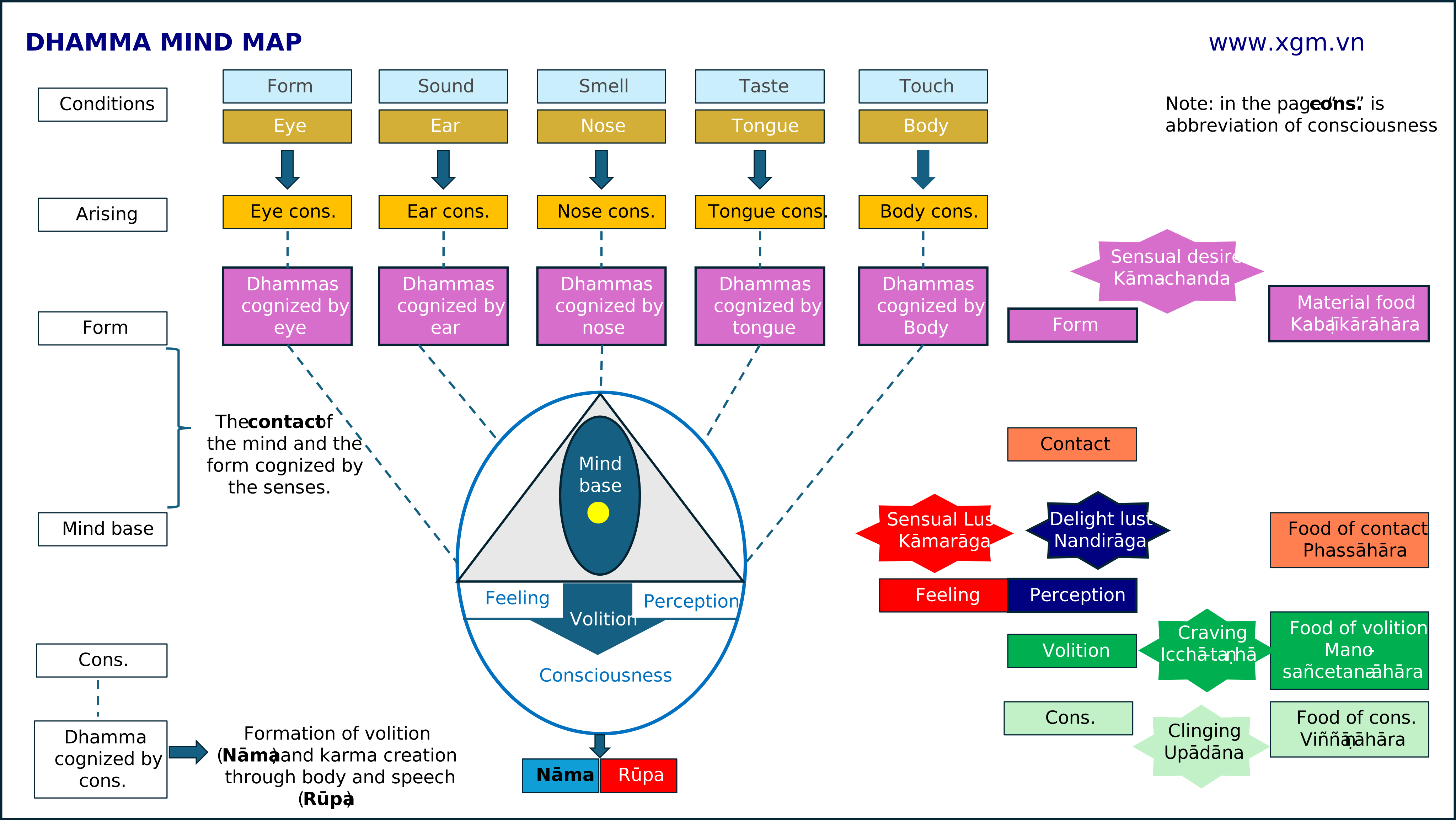
DESCRIPTION OF THE CHART
- Regarding the eye, forms, eye-consciousness, and dhammas cognized by eye-consciousness; due to the presence of desire, sensual lust, delight and lust, and craving, dhammas arise into active operation and become the means for the consciousness to engage in clinging, dogmatic stance, bias, and underlying tendencies. With a concentrated mind and wisdom (purified knowledge and vision), we will clearly see that the nature of those dhammas is impermanent, suffering, empty, and non-self. After clearly seeing with wisdom the destruction of that craving and grief, we skillfully observe all dhammas with a mind of equanimity. Through the absolute ending, dispassion, cessation, giving up, and relinquishment, our mind will achieve liberation and the knowledge and vision of liberation.
- Therefore, when seeing a form with the eye, we do not lust after pleasing forms, nor do we feel irritation toward unpleasing forms. We dwell with mindfulness established on the body, with an immeasurable and boundless mind, knowing as it really is the liberation of the mind from defilements (greed, hatred, delusion), and knowing as it really is the liberation by wisdom wherein those evil unwholesome states cease without remainder.
Similarly for the ear regarding sounds, the nose regarding smell, the tongue regarding tastes, the body regarding tactile objects, and the mind regarding dhammas.
Congratulations to the practitioner who is well on the path to enlightenment and liberation. At this stage, you can utilize the Heart Sutra to verify your own spiritual energy and progress in Dhamma study and practice. By reflecting upon the scriptural text, you will find this practice method directly corresponds to the verse: ‘When Avalokiteshvara Bodhisattva was practicing the deep Perfection of Wisdom, he illuminated and saw that the five aggregates are all empty, crossing over all suffering and distress,’ while simultaneously being able to fully comprehend the profound essence of this Heart Sutra (Topic 15, page Appendix).
The Four Foci of Mindfulness is the sole way
leading to purification and liberation